Category: Uncategorized

  • Zippered vs. Open vs. Ring-Binder Padfolios: Choosing the Right Format

    Zippered vs. Open vs. Ring-Binder Padfolios: Choosing the Right Format

    Most padfolio decisions get stuck on the cover material and skip the choice that actually shapes how the thing works in the hand: how it closes and what it is built to carry. An open padfolio, a zippered portfolio, and a ring-binder portfolio can all wear the same leather and the same logo, yet they behave completely differently at a trade show table, in a sales call, or in a training room. Picking the format first, then the material, is the order that keeps a bulk order from disappointing the people who have to use it.

    Open padfolios: light, affordable, and built for events

    The open padfolio is the workhorse of the category—a folded cover with a writing pad on one side and a panel of card slots and a pen loop on the other, with nothing holding it shut. That simplicity is the point. It is the lightest and least bulky format, the easiest to hand out by the hundred, and the most budget-friendly per unit, which is why it dominates conferences, campus recruiting, trade shows, and employee onboarding kits. When the goal is to put a branded, useful object in a lot of hands without overspending, this is the default.

    The trade-off is right there in the name. With no closure, papers can slide and the cover can flop open in a bag, so it protects contents the least. For a keepsake handed out at an event or a pad someone keeps on a desk, that rarely matters. For documents that travel loose in a briefcase every day, it matters more.

    Zippered portfolios: security and organization for client-facing work

    A zippered portfolio trades a little weight for a lot of protection and storage. The full zipper closes the case on all sides, so nothing falls out in transit and the contents stay private between meetings—useful in financial, legal, consulting, and healthcare settings where a client’s paperwork should not be visible on a table. Because the case closes completely, makers load it up: a tablet sleeve, multiple card and document pockets, a pen holder, and often a slot for a charging cable or a small power bank.

    That capacity is why the zippered format scores at the top for both storage and, despite the added bulk, everyday travel—the closure is what makes it safe to toss in a bag. It costs more than an open padfolio and weighs a bit more, so it fits executive gifts, sales teams, and anyone who carries their portfolio daily rather than one-off giveaways.
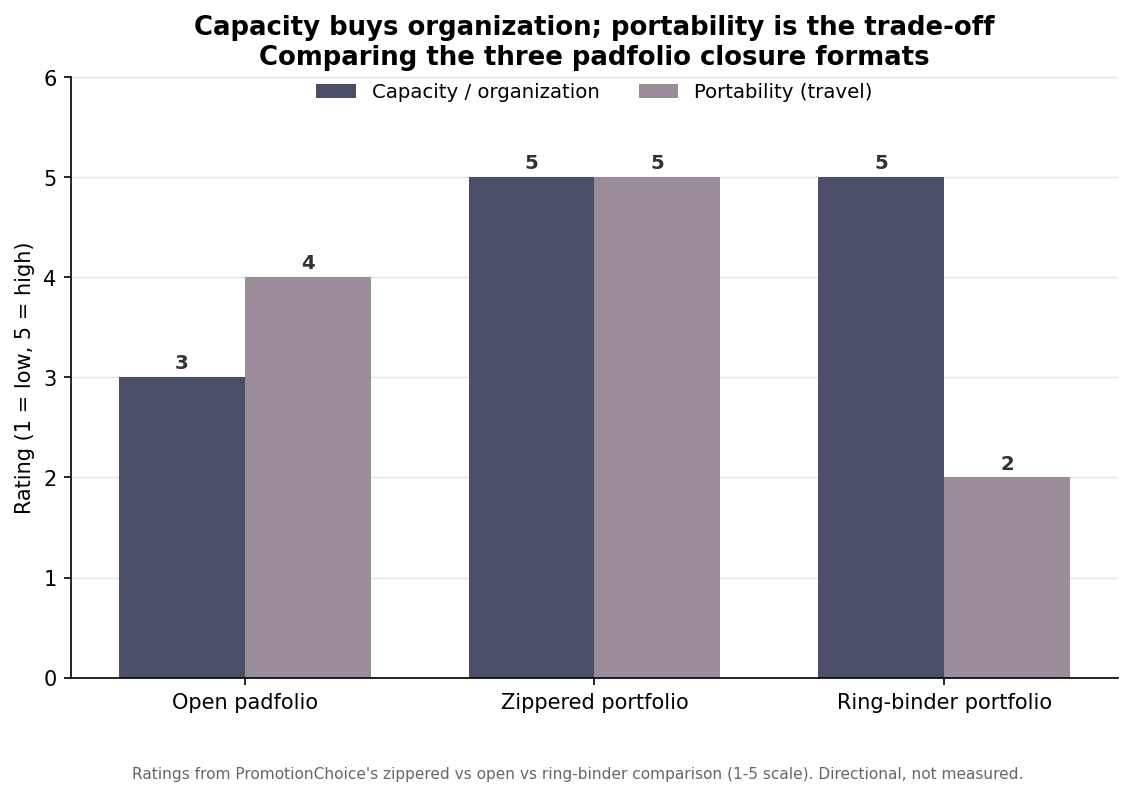
    Grouped bar chart comparing capacity and portability ratings for open, zippered, and ring-binder padfolios
    Zippered cases lead on capacity and travel; open padfolios stay light; ring binders trade portability for expandable pages.

    Ring-binder portfolios: when the paper is the point

    A ring-binder portfolio adds a metal ring mechanism so pages become the flexible part. Instead of a fixed pad, you get hole-punched sheets, tab dividers, and sheet protectors you can rearrange and expand, which suits training programs, field manuals, healthcare intake, and government or manufacturing documentation that changes often. Many come with an optional zipper, blending expandable paper storage with a secure closure.

    Rings are usually specified by diameter, and a modest half-inch to one-inch ring already holds a substantial stack of sheets—often a hundred or more—so most business portfolios stay on the smaller end rather than the deep three-inch rings you see on reference binders. The cost is footprint. The ring mechanism gives the portfolio a larger, heavier body than a standard padfolio, so it is the least portable of the three and the most likely to feel like carrying a binder—because it essentially is one. Choose it when the volume and reorganization of paper genuinely justify the bulk, not for the occasional note.

    Match the size to the pad and the device

    Format decides how it closes; size decides what fits inside. The two common footprints are letter and junior. A letter or A4 padfolio holds a full 8.5-by-11-inch (roughly 216-by-279 mm) writing pad and pairs naturally with an up-to-11-inch tablet or a slim tablet-laptop, which is what most professionals expect. A junior or A5 padfolio holds a compact 5-by-8-inch pad and suits a smaller tablet in the 8-inch class, making it easy to hold one-handed and slip into a smaller bag.

    If a device is going in the padfolio, confirm the sleeve dimensions against the exact tablet or laptop, since “fits an 11-inch tablet” varies by model and case thickness. Many universal sleeves cover a range such as 9.7 to 10.9 inches, but a snug fit beats an approximate one when the device rides in the cover every day.
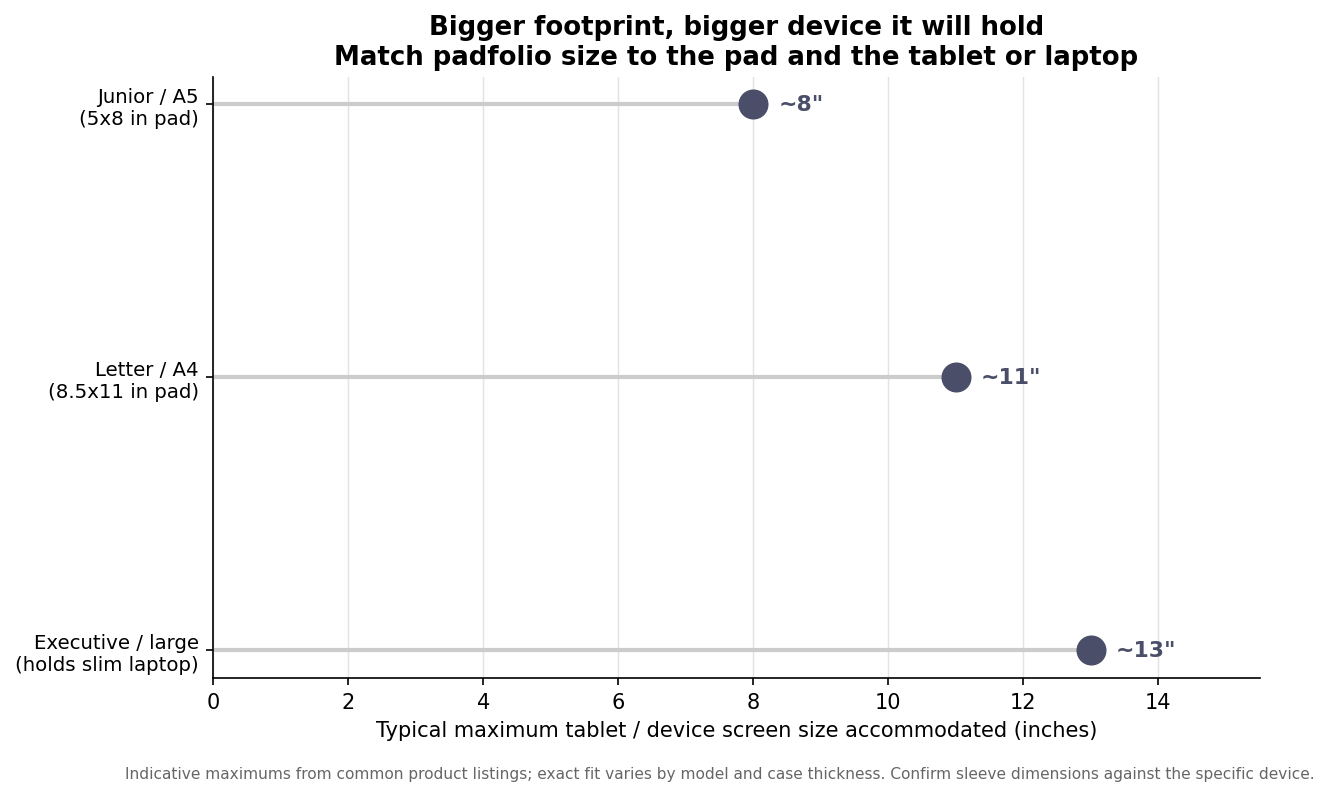
    Dot plot of the typical maximum device screen size accommodated by junior, letter, and executive padfolio sizes
    A larger padfolio footprint accommodates a larger tablet or laptop; confirm sleeve dimensions against the exact device.

    Choosing for a bulk order

    For a bulk purchase, start from who receives it and how they will use it. A large event or onboarding wave points to open padfolios in a letter size, because the low per-unit cost lets the budget reach more people and the format is unfussy. A gift for clients or a kit for a field sales team points to zippered portfolios, where the closure and the tablet sleeve earn their higher cost through daily use. A documentation-heavy program points to ring binders, accepting the bulk for the sake of expandable pages.

    It is also worth deciding whether one format covers everyone or whether a split order makes sense—open padfolios for the wider audience and a smaller run of zippered cases for the people who represent the brand in front of clients. Ordering two formats in the same cover material and logo keeps the set looking like one program while matching each group’s real need. Whatever the format, the branding rides on the cover, so the format choice does not limit your logo options—debossing, foil, laser, or print all work across the three. Decide the closure and the size against the real use case, lock in the pad footprint and any device sleeve dimensions, and only then choose the cover material and decoration. Ordered in that sequence, a bulk run lands as something people actually keep using rather than a drawer filler.
  • Choosing a Padfolio by Size and Format: A Use-Case Guide

    Choosing a Padfolio by Size and Format: A Use-Case Guide

    A padfolio order goes sideways when the buyer picks a cover they like and only later works out whether it holds the right pad, opens the right way, and suits the people who will carry it. The cover is the part everyone photographs, but the format decisions underneath it, the pad size, the closure, and the interior layout, are what make the padfolio useful or make it live in a drawer. This guide works from the job backward: figure out who carries the padfolio and what they do with it, then let that choose the size and features rather than the other way around.

    The three sizes, and what actually fits inside

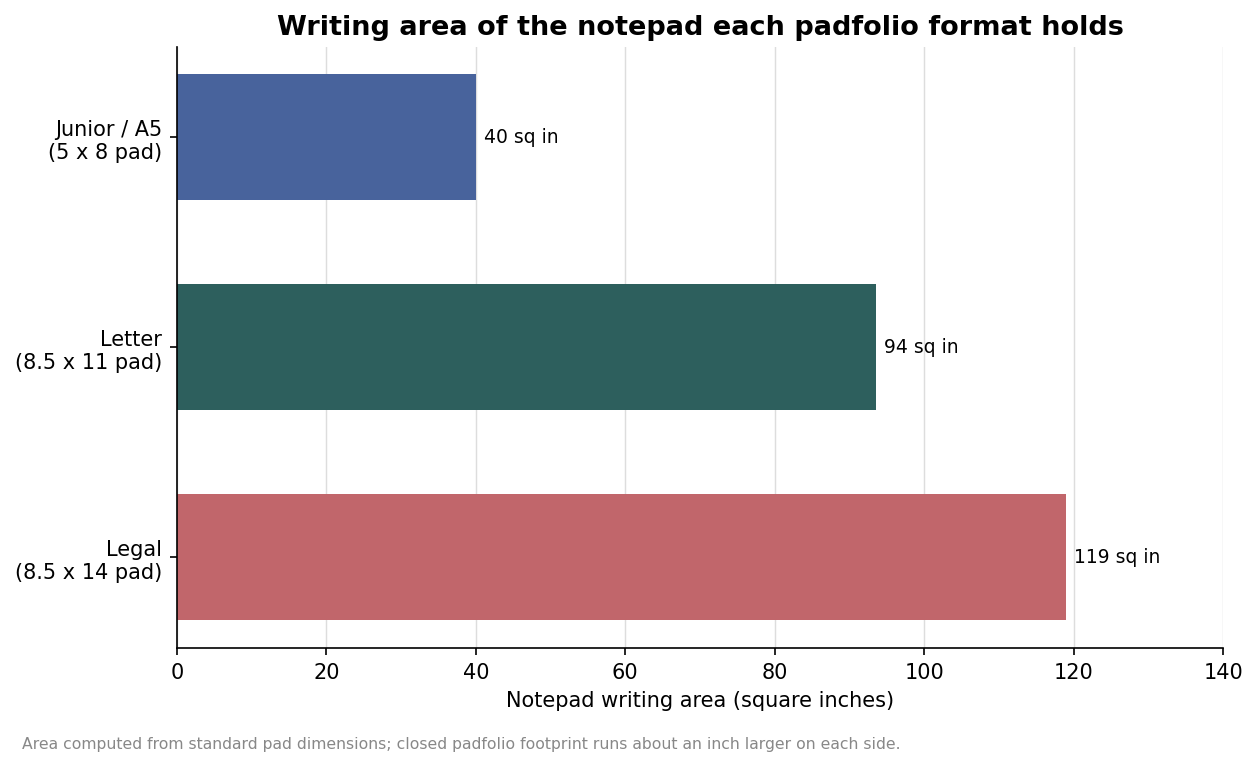
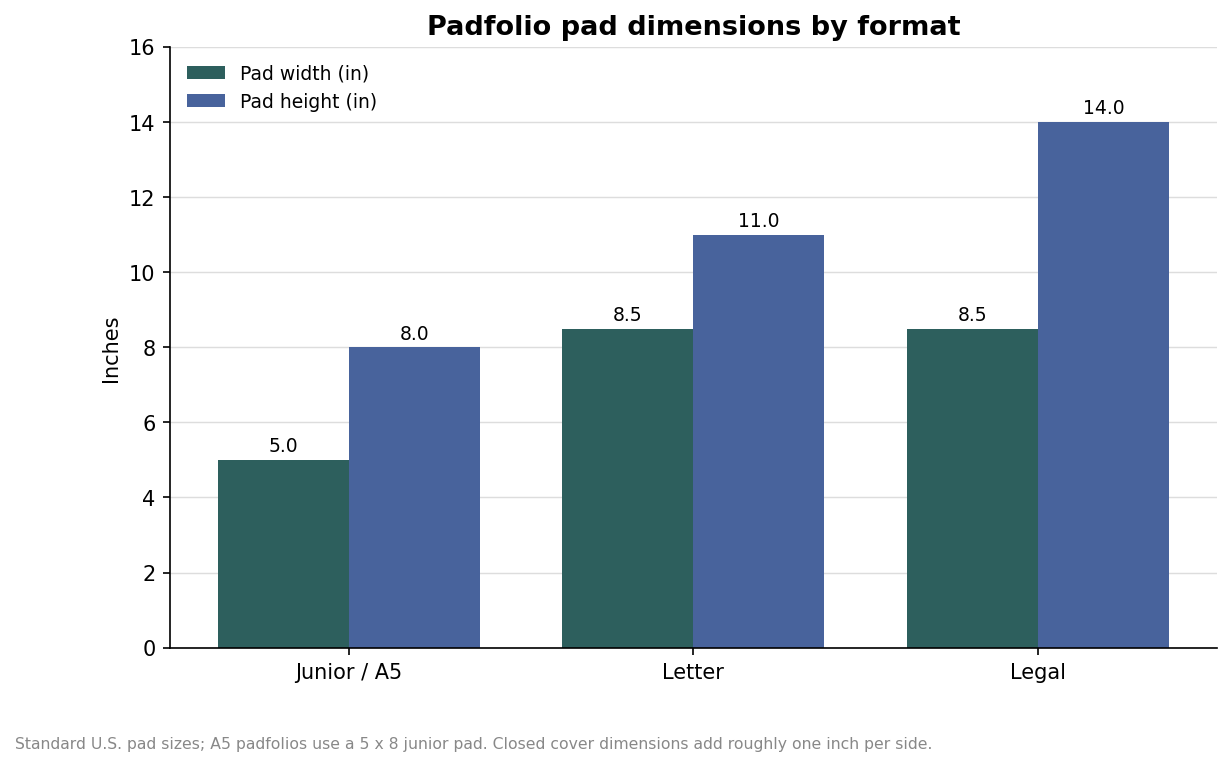
    Padfolios come in three practical sizes, defined by the notepad they hold. A letter padfolio takes an 8.5 by 11 inch pad and is the default for everyday meetings, note taking, and most office documents; if you are buying one size for a mixed audience, this is it. A legal padfolio holds an 8.5 by 14 inch pad and earns its space in legal, finance, and any role that routinely handles longer documents or contracts. A junior or A5 padfolio carries a compact 5 by 8 inch pad and suits quick notes, commuting, and anyone who wants to travel light. The difference is larger than it sounds: a letter pad gives you roughly 94 square inches of writing surface, a legal pad about 119, and a junior pad only 40, so the small format is genuinely a different tool rather than a slightly smaller version of the same one.

    Horizontal bar chart comparing notepad writing area for junior, letter, and legal padfolio formats
    The three formats differ sharply in writing surface, so size is a real tool choice, not a cosmetic one.

    Remember that the closed cover runs about an inch larger than the pad on every side, so a letter padfolio is roughly 9.5 by 12 inches shut. That matters when the padfolio has to slide into a bag or sit inside a welcome kit box, and it is the dimension worth confirming on a sample before you commit a bulk run.

    Closure: open, snap, or zippered

    How the padfolio closes says as much about its use as its size. An open or folio style with no closure is fastest to use and reads as the classic meeting portfolio; it is ideal for desk and conference-room work where nothing needs to be locked down. A snap or magnetic closure keeps the cover shut and the contents tidy while still opening in one motion, a sensible middle ground for people who move between rooms. A zippered closure seals the whole perimeter so nothing slides out in a bag, which is what you want for travel, field sales, and any padfolio that doubles as a small carry-all with a tablet inside. Each step toward more security adds a little bulk and cost, so match the closure to how far the padfolio actually travels rather than defaulting to the most enclosed option.

    Match the format to the job

    Once size and closure are on the table, the use case usually points to a clear answer. For sales teams and field staff, a zippered letter padfolio with a tablet sleeve and a few card slots holds a demo device, a pad, and leave-behinds in one piece that survives a car and a trade-show floor. For executive gifts and client-facing leaders, an open or snap-closed letter padfolio in a premium cover material makes the impression, and the branding stays subtle. For employee onboarding and welcome kits, a letter padfolio balances perceived value against a per-unit budget that has to scale across every new hire, and it photographs well in an unboxing. For conferences and event swag, a junior or A5 padfolio lowers the unit cost and the weight in an attendee bag while still carrying a logo people keep. The pattern is consistent: heavier, more enclosed formats go to the people who travel with them, and lighter, simpler formats go to high-volume giveaways.

    Grouped bar chart of pad width and height in inches for junior, letter, and legal padfolios
    Pad dimensions by format; the closed cover adds about an inch on each side.

    Features that earn their place

    Interior layout is where padfolios quietly diverge. Nearly all include document pockets, a business-card slot or two, and a pen loop, and those are safe to assume. The features worth deciding on deliberately are the tablet or tech pocket, which turns the padfolio into a device carrier but adds thickness; the ring binder, where a three-ring or four-pocket version holds letter-size printouts for people who present from paper; and the refill system, since a padfolio outlives many pads and a standard refill size keeps it in service for years. Every added compartment raises cost and bulk, so the useful question for a bulk order is which two or three features the recipients will actually use, not how many the cover can hold.

    Sizing the order to the audience

    When the format is settled, the last decision is quantity against configuration, and mixing the two is where budgets slip. A single specification across the whole run keeps the unit price down and the artwork consistent, which is why most bulk buyers standardize on one size and closure and vary only the branding. If the audience genuinely splits, for example a premium zippered padfolio for the sales team and a lighter junior padfolio for event giveaways, treat them as two separate runs with their own quantities rather than trying to average them into one compromise that serves neither. Order a physical sample of the exact size and cover before the full run, check that your real pad and any device slide in cleanly, and confirm the closed footprint fits wherever the padfolio has to live. Those few steps turn a padfolio from a nice-looking object into one people actually carry.

  • Padfolio Cover Materials Explained: Genuine, PU, Microfiber, and Bonded Leather

    Padfolio Cover Materials Explained: Genuine, PU, Microfiber, and Bonded Leather

    A padfolio is one of the few promotional or executive gifts that lives on a desk for years, which means the cover material is not a cosmetic choice. It decides whether the piece still looks credible at the third client meeting or whether it has started shedding flakes of its own surface. The writing pad inside is a consumable that gets refilled; the cover is the asset that carries your logo the whole time. Four materials dominate the market, and they behave very differently over their lifespans. Understanding them is the difference between a padfolio that ages into a patina and one that peels within a year, and the gap in real-world durability between the cheapest and the most durable option is measured in years, not months.

    Genuine leather: what the premium actually buys

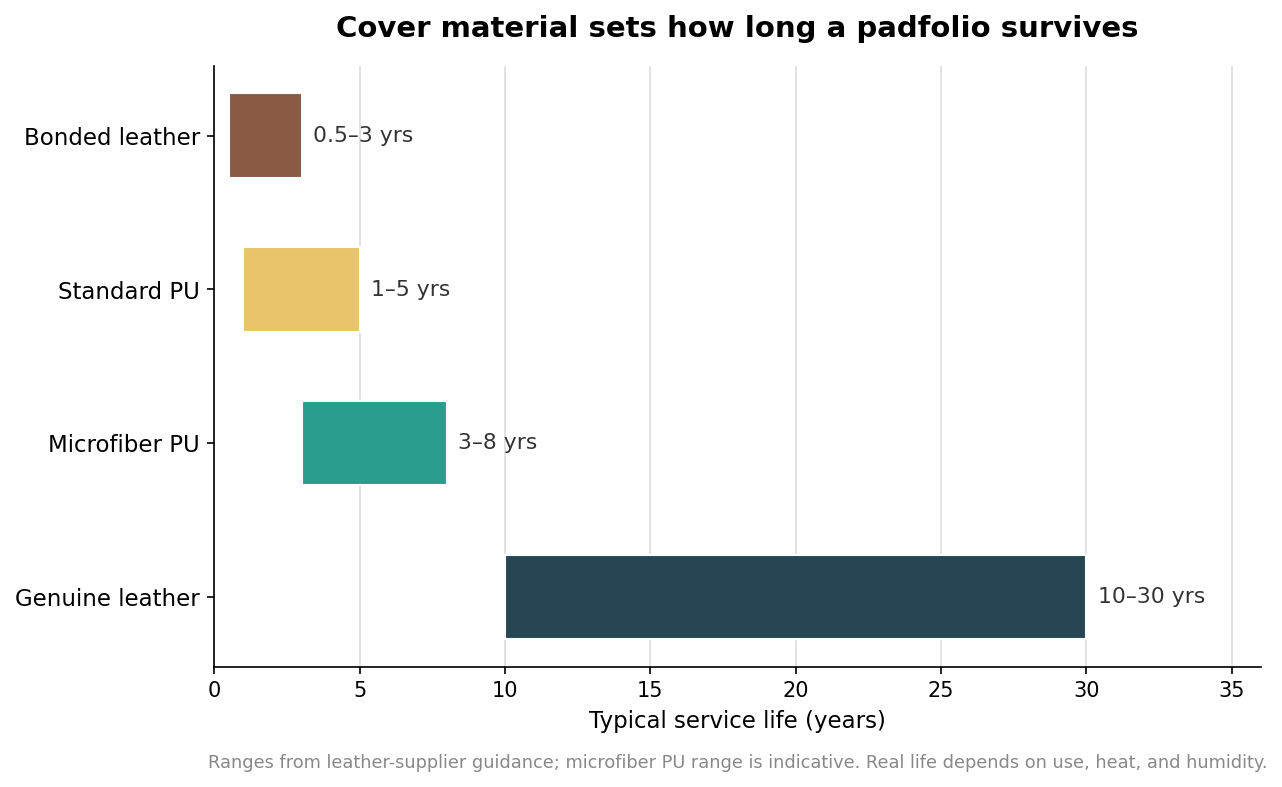
    Genuine leather is a single, coherent piece of animal hide, and its structure is why it lasts. The natural collagen fibers resist cracking, scratches tend to blend into a patina rather than becoming permanent defects, and the material breathes, exchanging moisture instead of trapping it. With basic care, a genuine leather cover commonly lasts 10 to 20 years or more, and high-quality hides can stay in service for decades. The tradeoffs are cost and consistency: real hide carries the highest material price, and every panel has unique grain variation, so no two covers are perfectly identical. For a flagship gift or an executive-tier order where longevity and feel are the point, that variability is a feature. For a large uniform run where every unit must match, it can be a complication, and it is worth requesting production samples so you can see how much grain variation to expect before the full order runs.

    Horizontal range chart of padfolio cover material service life in years for bonded, PU, microfiber, and genuine leather
    Typical service life by cover material; genuine leather outlasts the synthetics by years.

    PU and microfiber: the synthetic workhorses

    Polyurethane (PU) leather is a fabric or backing coated with a polyurethane skin that is embossed with a grain pattern. It is far cheaper than hide, completely uniform panel to panel, and easy to keep clean, which is why it dominates promotional padfolios. Its honest limitation is lifespan: standard PU typically holds up for about 1 to 5 years depending on quality and conditions, and because the surface is a coating, it is prone to cracking and peeling at high-stress points like the spine fold and edges, a process that cannot be reversed once it starts. PU is also non-breathable, so trapped moisture in humid environments speeds its breakdown, and covers stored in hot cars or sunny windows tend to fail fastest.

    Microfiber leather is the premium end of the synthetic category: an ultrafine fiber base topped with polyurethane, engineered to behave more like real leather. It is more durable and more abrasion-resistant than standard PU while keeping the uniform surface that makes branding predictable, and it typically outlasts ordinary PU by a meaningful margin, though exact figures vary by grade and are best treated as indicative rather than guaranteed. When a buyer wants the consistency and price advantages of a synthetic but needs the piece to survive daily handling, microfiber is usually the upgrade worth paying for, and it often costs only modestly more than standard PU while lasting noticeably longer.

    Bonded leather: the label to understand before you buy

    Bonded leather causes more disappointment than any other cover material, mostly because its name implies more than it delivers. It is manufactured by shredding leather scraps into fiber, blending that fiber with polyurethane or latex binders, pressing the mix onto a fabric backing, and finishing it with a PU topcoat and an embossed grain. The real leather content is typically only 10 to 30 percent, and the visible surface you touch is the glued-on PU layer, not leather at all. Because that top layer is bonded rather than naturally connected, it separates under heat, humidity, sweat, friction, and UV, so the characteristic failure is peeling and delamination. Expected service life is short, often quoted at roughly six months to three years, which is why bonded leather is best reserved for low-cost, short-cycle giveaways where nobody expects the piece to last. If a supplier offers “leather” at a price that seems too good to be true, confirm whether it is bonded before you commit a large order, and ask directly for the leather-fiber percentage rather than accepting the word leather on its own.

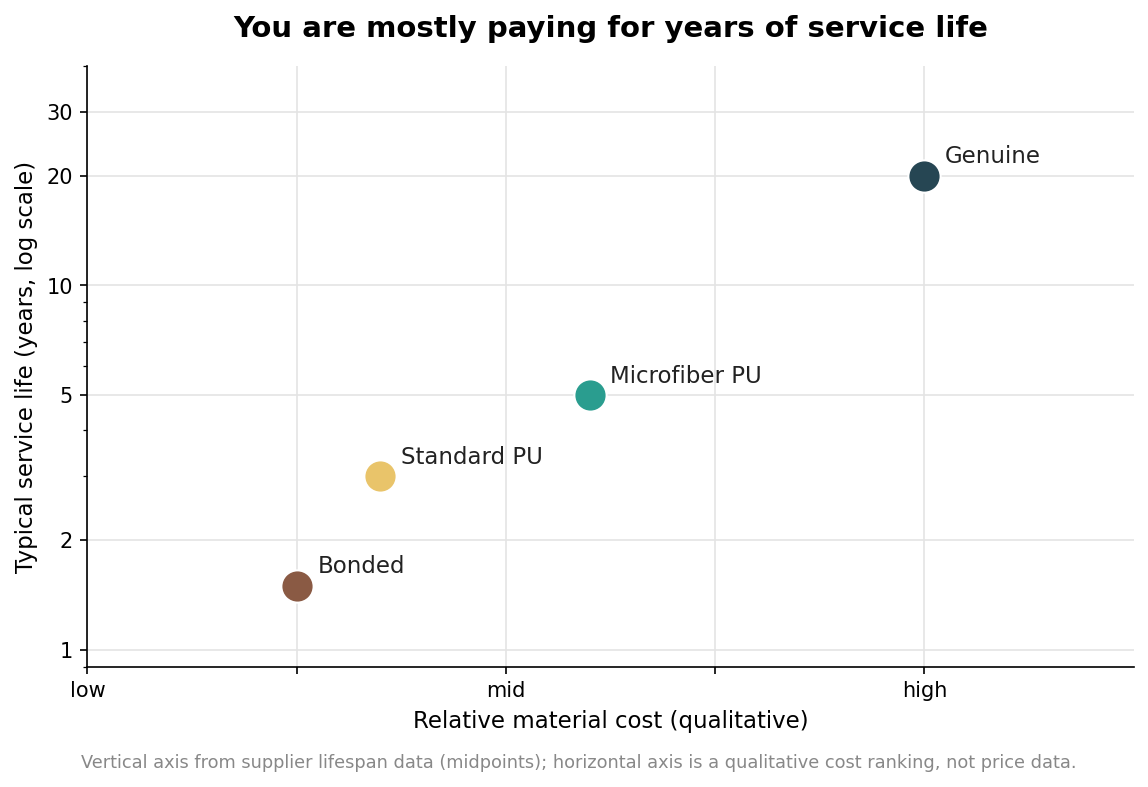
    Scatter plot positioning padfolio cover materials by relative cost and typical service life in years
    Higher material cost mostly buys more years of service; cost axis is a qualitative ranking.

    Matching material to budget, lifespan, and branding

    The clean way to decide is to work backward from how long the padfolio needs to look good and how it will be decorated. If it is a keepsake or executive gift meant to last for years and develop character, genuine leather earns its premium and takes debossing and blind embossing beautifully because the hide has real depth to press into. If it is a bulk promotional run where cost per unit and visual consistency matter most, a quality PU or, better, microfiber cover gives you a uniform surface that reproduces a foil-stamped or debossed logo identically across every unit. If the budget only allows bonded leather, go in with eyes open: it photographs well and feels leather-like on day one, but plan for a lifespan measured in months, not years, and avoid it for anything a recipient is meant to keep. Two questions settle most orders: how many years does this need to survive, and does every unit need to look the same? Answer those honestly and the material chooses itself, and your logo rides on a surface that is still intact when it matters.

  • How to Put Your Logo on a Padfolio: Debossing, Foil, Laser, and Print

    How to Put Your Logo on a Padfolio: Debossing, Foil, Laser, and Print

    The cover of a padfolio is the only part anyone sees across a conference table, and it is the part your logo lives on for years. Yet the branding decision usually gets made in a single line on an order form, “add our logo,” with no thought to how that logo gets there. There are five common ways to put a mark on a padfolio cover, and they differ enormously in look, durability, cost, and which cover materials they even work on. Choosing the wrong one is how a crisp logo ends up cracked, faded, or peeling a year in.

    Blind debossing: the quiet default

    Debossing presses your logo into the cover with a heated metal die, leaving a recessed impression without cutting the material. On genuine leather the process runs at roughly 120 to 180°C with a few tons of pressure for several seconds, and because it compresses the surface rather than adding anything on top, the result is exceptionally durable; a good deboss on grain leather can stay sharp through tens of thousands of abrasion cycles. It reads as understated and premium, which is exactly why executive gifts and law firms lean on it.

    The economics are its main constraint. Debossing requires a custom die, which is a one-time tooling charge, after which the per-unit cost is low on larger runs. That structure rewards volume and punishes small orders, a dynamic worth looking at directly before you commit.

    The logic is simple. Spread a die charge across a small run and the setup adds noticeably to each padfolio; spread it across a large run and it nearly disappears. At higher volumes, debossing overtakes a no-die method like laser engraving on total cost, while on smaller runs the tooling charge dominates. The exact crossover shifts with your quote, but the shape is always the same.

    Foil stamping and embossing: when you want it to catch light

    Foil stamping uses the same die-and-heat approach as debossing but presses a thin metallic film into the impression, leaving a shiny gold, silver, or colored mark. It is frequently combined with a deboss so the foil sits in a recess and resists rubbing off. Foil is the move when quiet elegance is not the goal and you want the logo to read from across a room, and it carries similar tooling economics to debossing since it also needs a die. Embossing is the inverse operation, raising the logo above the surface instead of pushing it in; it shares the same die requirement and suits covers where a tactile, raised crest is the point. All three of these die-based methods share the same kind of one-time tooling charge, which is the first thing to notice when you compare methods.

    Laser engraving: precision without a die

    Laser engraving vaporizes the top fraction of a millimeter of the surface, guided by a digital file, so it needs no physical die at all. Setup is essentially a file and under an hour of programming, which is why the per-unit cost stays flat whether you order twelve or five hundred. That makes it the economical choice for small and mid-size runs, and its precision handles fine detail and small type that a die can struggle with. On many faux-leather and PU covers, the laser also reveals a contrasting base layer underneath, producing a crisp two-tone mark. The trade-off is at the top end: because the per-unit cost never drops, high-volume orders eventually cost more than a debossed equivalent, and on some softer or sealed surfaces the engraved line can lighten over time faster than a pressed impression.

    Printing and embroidery: for color and fabric covers

    When the logo needs full color, printing is the only real option. Pad printing transfers ink from a silicone pad and works well on leather and vinyl for smaller, detailed marks; screen printing suits larger, bolder artwork. Both reproduce brand colors that debossing and engraving simply cannot, at a modest plate or screen setup rather than a die charge. The caveat is durability: a printed mark sits on the surface and will wear with heavy handling more readily than an impression pressed into the material. For cloth, microfiber, or heathered fabric covers, embroidery is the natural fit, stitching the logo in thread for a textured, durable finish that leather-oriented methods were never designed for. Match the method to the cover: pressed and engraved methods for leather and leather-like surfaces, print for color, embroidery for textiles.

    Matching method to material and quantity

    The decision comes down to three inputs. First, the cover material: genuine and faux leather take debossing, foil, and laser cleanly, while fabric covers want embroidery and only color-critical logos justify printing. Second, the look: understated points to blind deboss, eye-catching to foil, full color to print. Third, the quantity, which is where the tooling math decides between a die-based method and laser. As a rough rule, small and mid runs favor laser for its zero tooling, while orders past roughly a thousand favor debossing or foil as the die cost melts away. Die charges, per-unit rates, and the exact break-even all move with your material, quantity, and artwork, so treat this as the shape of the decision and request a free mockup and quote for the specifics before you commit to a bulk order.

  • Why Padfolios Crack Down the Spine

    A pale line down the fold, then a split. It happens to expensive folios as often as cheap ones, and the cause is always the same.

    What is actually happening

    Two stiff boards sit inside the cover, one for each face. If they are butted close together, the cover material has to bridge a hard edge and stretch across it every time the folio is opened.

    Materials tolerate bending far better than they tolerate stretching. A PU skin whitens and then splits; a coated fabric goes fluffy; even good hide takes a hard gray crease.

    The relief gap

    Leave a channel between the boards — a few millimeters of unsupported material — and the cover folds along it instead of stretching over a corner.

    It also changes how the folio behaves on a desk. A relieved spine lets the cover fall open and stay open; a butted one springs shut the moment you let go.

    Where the stitching goes

    A stitch line is a row of holes. Run it down the fold and you have perforated the exact line the material has to flex on.

    Beside the fold, it does the same job and none of the damage.

    What leather needs on top of that

    Hide at full thickness across a spine bulks and resists, so the fold concentrates in one hard line. Skiving — thinning a band of the hide before it is folded — is what lets a leather folio soften with use rather than crease.

    Burnished edges rather than raw cut ones are the other half of the same job.

  • The Pad Is a Consumable. The Cover Is the Asset.

    The cover is the thing you are paying to brand, and it should still be in use long after the paper inside it has been replaced many times over.

    Stock sizes only

    Letter for full-size covers, 5 x 8 for junior ones. Both are sold by every stationer and will still be sold in five years.

    A cover cut around a bespoke pad looks identical on the quote and becomes landfill the day the original refill runs out, because nobody will re-order a special pad for an old folio.

    How the pad is held matters as much as its size

    A board retainer or an elastic lets a pad be swapped in seconds. Glue does not.

    A glued pad also sheds: the adhesive strip lets go in a warm bag and the pad ends up loose at the bottom of it, which is the second-most-common complaint we hear.

    Ring binders are the same argument

    The reason to buy a ring folio is that pages come out and go back in. That only holds if the mechanism is riveted through the back board.

    Glued and heat-welded mechanisms peel under the weight of a full manual and usually take a strip of the lining with them.

    What this means when you order

    Ask for the pad size by name, ask how it is retained, and ask what a replacement pad costs at a normal stationer.

    If a supplier cannot answer all three, the cover is being sold as though it were disposable, whatever it costs.

  • The Complete Buyer’s Guide to Custom Padfolios

    Padfolios all look the same on a quote sheet. Four questions tell you which ones will still be in use next year.

    Ask how the spine is built

    The single most common failure is a crack down the fold, and it is caused by wrapping the cover tight over two hard boards with no relief gap, so the material stretches over an edge on every open.

    Ask whether there is a relief channel at the spine, and whether the stitch line runs down the fold or beside it. A line of stitch perforations through a hinge is a tear waiting to happen.

    Decide the closure on how it will be used

    A tuck flap has nothing in it to fail. A magnetic flap is next, and it is quieter to open in a room full of people. A zip is the most secure and the most likely to break.

    If you do choose a zip, ask whether the corners are radiused. Square corners force the tape to turn faster than the teeth can and eventually lift one.

    Check the pad size before anything else

    This is the cheapest mistake to avoid and the most expensive to live with. A cover built around a bespoke pad is disposable the moment the original refill runs out.

    Specify a stock letter pad, or 5 x 8 for a junior cover. Then check the pad is held on a retainer or elastic rather than glued in, because a glued pad cannot be replaced at all.

    Match the decoration to the material

    Blind deboss reads as quality on full-grain hide and never rubs off. Foil is brighter for a mark that must be legible across a room. Cork takes a laser mark beautifully.

    On PU and recycled covers, a die run at leather temperature glosses the surface and leaves a shiny halo around the mark. It should be run cooler and proofed on your actual material.

    What to send when you ask for a quote

    Artwork, quantity, cover material, pad size, and whether it will be carried daily or handed out once. That is enough for a real quote and a mockup the same day.