Most padfolio decisions get stuck on the cover material and skip the choice that actually shapes how the thing works in the hand: how it closes and what it is built to carry. An open padfolio, a zippered portfolio, and a ring-binder portfolio can all wear the same leather and the same logo, yet they behave completely differently at a trade show table, in a sales call, or in a training room. Picking the format first, then the material, is the order that keeps a bulk order from disappointing the people who have to use it.
Open padfolios: light, affordable, and built for events
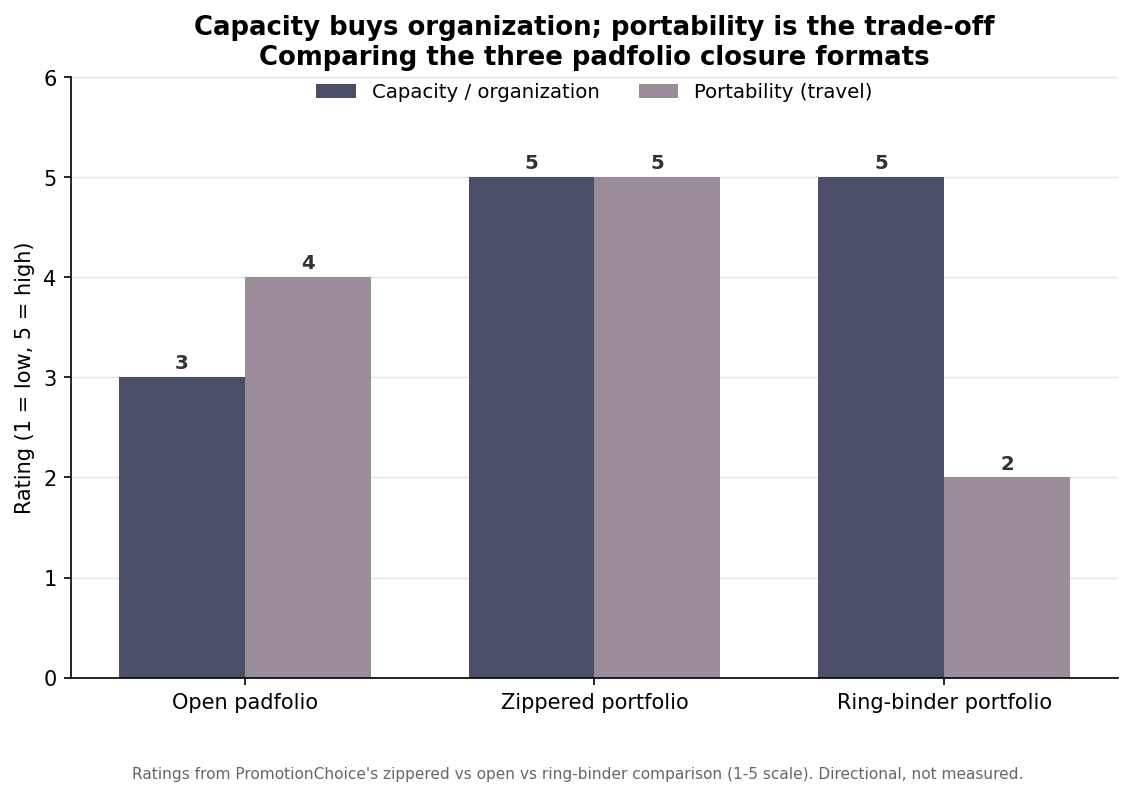
The open padfolio is the workhorse of the category—a folded cover with a writing pad on one side and a panel of card slots and a pen loop on the other, with nothing holding it shut. That simplicity is the point. It is the lightest and least bulky format, the easiest to hand out by the hundred, and the most budget-friendly per unit, which is why it dominates conferences, campus recruiting, trade shows, and employee onboarding kits. When the goal is to put a branded, useful object in a lot of hands without overspending, this is the default.
The trade-off is right there in the name. With no closure, papers can slide and the cover can flop open in a bag, so it protects contents the least. For a keepsake handed out at an event or a pad someone keeps on a desk, that rarely matters. For documents that travel loose in a briefcase every day, it matters more.
Zippered portfolios: security and organization for client-facing work
A zippered portfolio trades a little weight for a lot of protection and storage. The full zipper closes the case on all sides, so nothing falls out in transit and the contents stay private between meetings—useful in financial, legal, consulting, and healthcare settings where a client’s paperwork should not be visible on a table. Because the case closes completely, makers load it up: a tablet sleeve, multiple card and document pockets, a pen holder, and often a slot for a charging cable or a small power bank.
That capacity is why the zippered format scores at the top for both storage and, despite the added bulk, everyday travel—the closure is what makes it safe to toss in a bag. It costs more than an open padfolio and weighs a bit more, so it fits executive gifts, sales teams, and anyone who carries their portfolio daily rather than one-off giveaways.
Ring-binder portfolios: when the paper is the point
A ring-binder portfolio adds a metal ring mechanism so pages become the flexible part. Instead of a fixed pad, you get hole-punched sheets, tab dividers, and sheet protectors you can rearrange and expand, which suits training programs, field manuals, healthcare intake, and government or manufacturing documentation that changes often. Many come with an optional zipper, blending expandable paper storage with a secure closure.
Rings are usually specified by diameter, and a modest half-inch to one-inch ring already holds a substantial stack of sheets—often a hundred or more—so most business portfolios stay on the smaller end rather than the deep three-inch rings you see on reference binders. The cost is footprint. The ring mechanism gives the portfolio a larger, heavier body than a standard padfolio, so it is the least portable of the three and the most likely to feel like carrying a binder—because it essentially is one. Choose it when the volume and reorganization of paper genuinely justify the bulk, not for the occasional note.
Match the size to the pad and the device
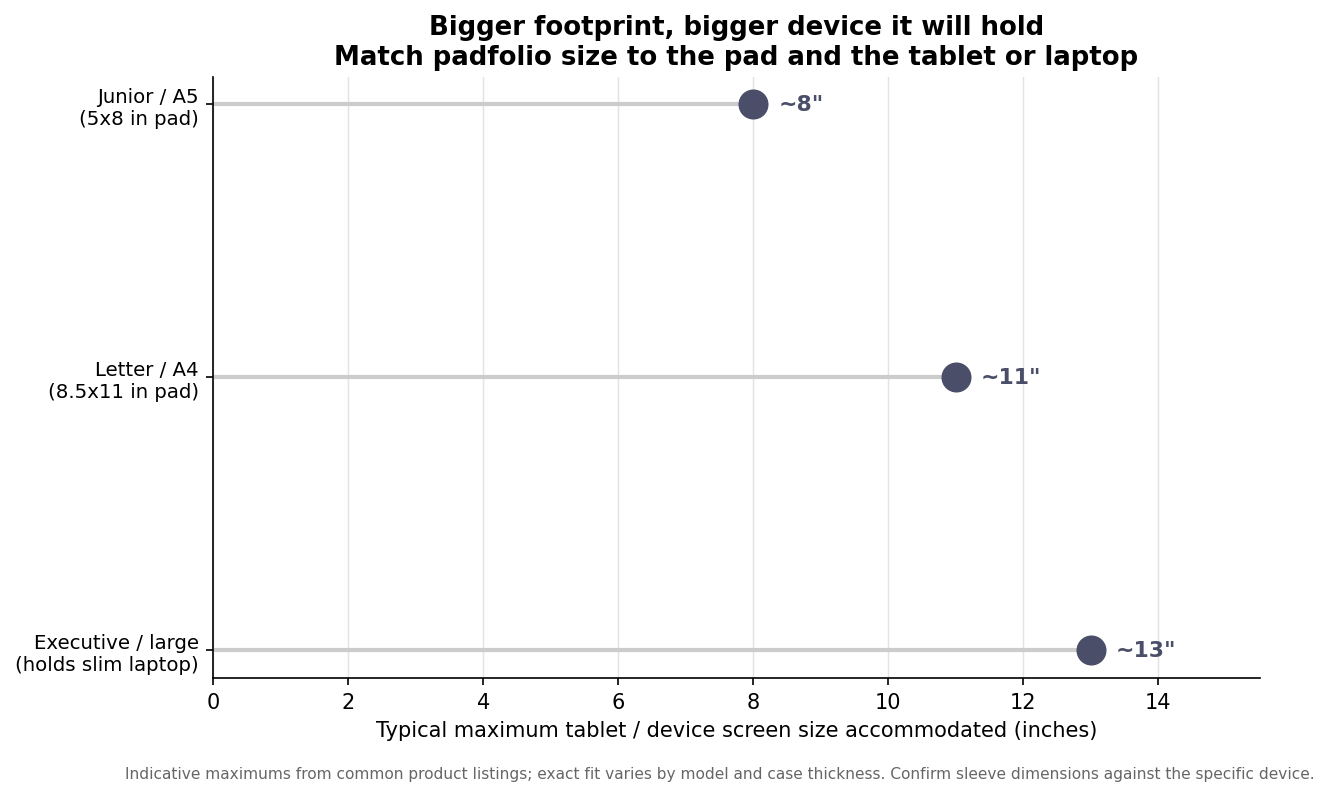
Format decides how it closes; size decides what fits inside. The two common footprints are letter and junior. A letter or A4 padfolio holds a full 8.5-by-11-inch (roughly 216-by-279 mm) writing pad and pairs naturally with an up-to-11-inch tablet or a slim tablet-laptop, which is what most professionals expect. A junior or A5 padfolio holds a compact 5-by-8-inch pad and suits a smaller tablet in the 8-inch class, making it easy to hold one-handed and slip into a smaller bag.
If a device is going in the padfolio, confirm the sleeve dimensions against the exact tablet or laptop, since “fits an 11-inch tablet” varies by model and case thickness. Many universal sleeves cover a range such as 9.7 to 10.9 inches, but a snug fit beats an approximate one when the device rides in the cover every day.
Choosing for a bulk order
For a bulk purchase, start from who receives it and how they will use it. A large event or onboarding wave points to open padfolios in a letter size, because the low per-unit cost lets the budget reach more people and the format is unfussy. A gift for clients or a kit for a field sales team points to zippered portfolios, where the closure and the tablet sleeve earn their higher cost through daily use. A documentation-heavy program points to ring binders, accepting the bulk for the sake of expandable pages.
It is also worth deciding whether one format covers everyone or whether a split order makes sense—open padfolios for the wider audience and a smaller run of zippered cases for the people who represent the brand in front of clients. Ordering two formats in the same cover material and logo keeps the set looking like one program while matching each group’s real need. Whatever the format, the branding rides on the cover, so the format choice does not limit your logo options—debossing, foil, laser, or print all work across the three. Decide the closure and the size against the real use case, lock in the pad footprint and any device sleeve dimensions, and only then choose the cover material and decoration. Ordered in that sequence, a bulk run lands as something people actually keep using rather than a drawer filler.