A padfolio order goes sideways when the buyer picks a cover they like and only later works out whether it holds the right pad, opens the right way, and suits the people who will carry it. The cover is the part everyone photographs, but the format decisions underneath it, the pad size, the closure, and the interior layout, are what make the padfolio useful or make it live in a drawer. This guide works from the job backward: figure out who carries the padfolio and what they do with it, then let that choose the size and features rather than the other way around.
The three sizes, and what actually fits inside
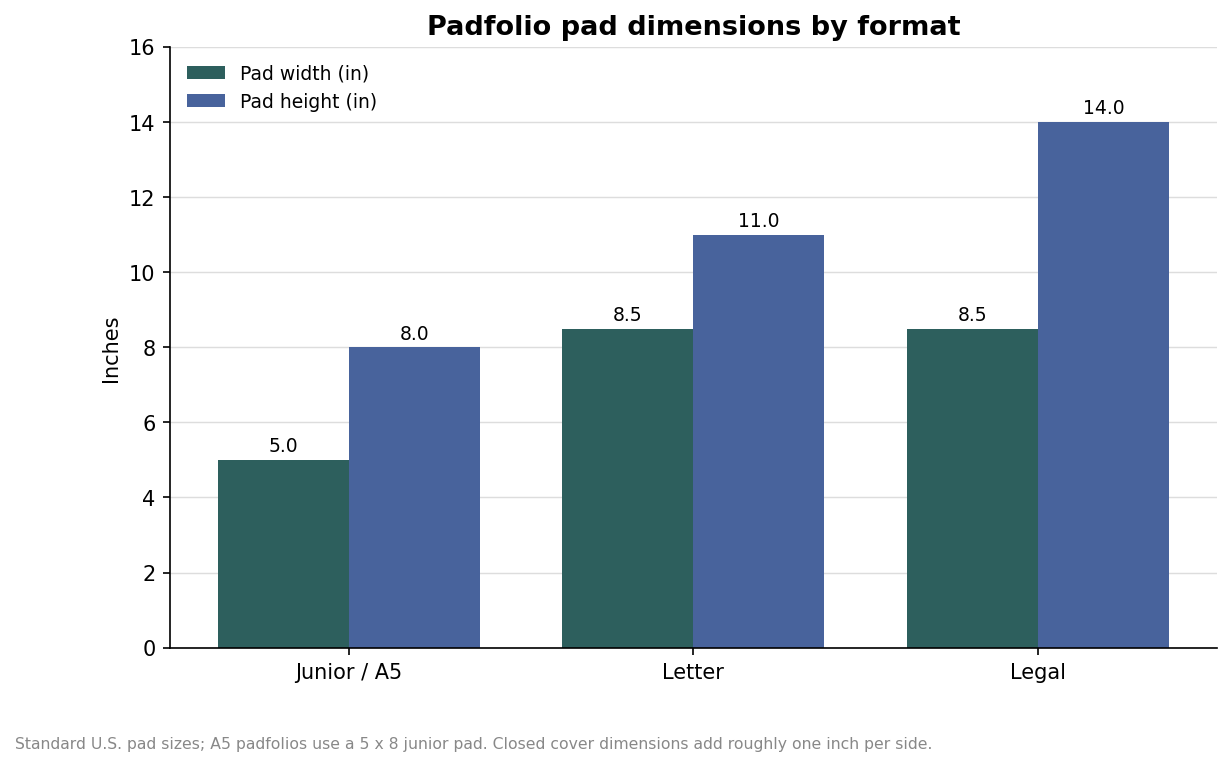
Padfolios come in three practical sizes, defined by the notepad they hold. A letter padfolio takes an 8.5 by 11 inch pad and is the default for everyday meetings, note taking, and most office documents; if you are buying one size for a mixed audience, this is it. A legal padfolio holds an 8.5 by 14 inch pad and earns its space in legal, finance, and any role that routinely handles longer documents or contracts. A junior or A5 padfolio carries a compact 5 by 8 inch pad and suits quick notes, commuting, and anyone who wants to travel light. The difference is larger than it sounds: a letter pad gives you roughly 94 square inches of writing surface, a legal pad about 119, and a junior pad only 40, so the small format is genuinely a different tool rather than a slightly smaller version of the same one.
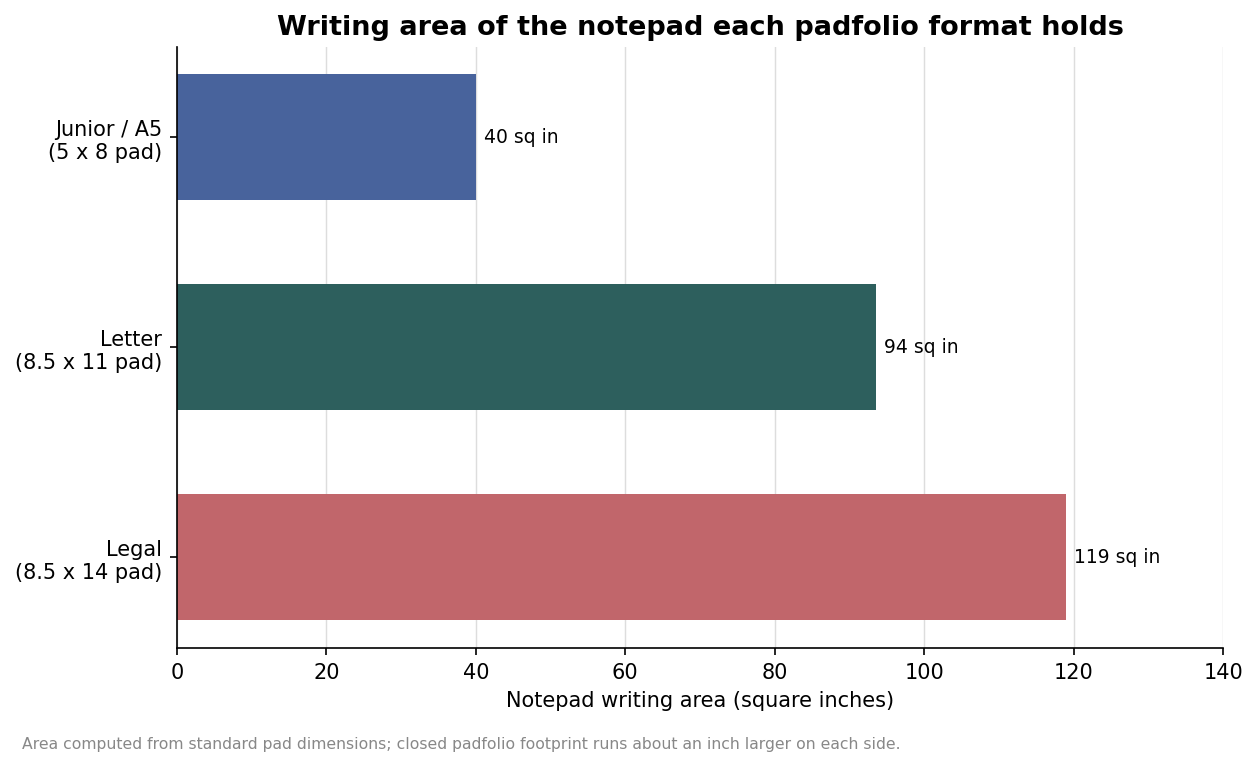
Remember that the closed cover runs about an inch larger than the pad on every side, so a letter padfolio is roughly 9.5 by 12 inches shut. That matters when the padfolio has to slide into a bag or sit inside a welcome kit box, and it is the dimension worth confirming on a sample before you commit a bulk run.
Closure: open, snap, or zippered
How the padfolio closes says as much about its use as its size. An open or folio style with no closure is fastest to use and reads as the classic meeting portfolio; it is ideal for desk and conference-room work where nothing needs to be locked down. A snap or magnetic closure keeps the cover shut and the contents tidy while still opening in one motion, a sensible middle ground for people who move between rooms. A zippered closure seals the whole perimeter so nothing slides out in a bag, which is what you want for travel, field sales, and any padfolio that doubles as a small carry-all with a tablet inside. Each step toward more security adds a little bulk and cost, so match the closure to how far the padfolio actually travels rather than defaulting to the most enclosed option.
Match the format to the job
Once size and closure are on the table, the use case usually points to a clear answer. For sales teams and field staff, a zippered letter padfolio with a tablet sleeve and a few card slots holds a demo device, a pad, and leave-behinds in one piece that survives a car and a trade-show floor. For executive gifts and client-facing leaders, an open or snap-closed letter padfolio in a premium cover material makes the impression, and the branding stays subtle. For employee onboarding and welcome kits, a letter padfolio balances perceived value against a per-unit budget that has to scale across every new hire, and it photographs well in an unboxing. For conferences and event swag, a junior or A5 padfolio lowers the unit cost and the weight in an attendee bag while still carrying a logo people keep. The pattern is consistent: heavier, more enclosed formats go to the people who travel with them, and lighter, simpler formats go to high-volume giveaways.
Features that earn their place
Interior layout is where padfolios quietly diverge. Nearly all include document pockets, a business-card slot or two, and a pen loop, and those are safe to assume. The features worth deciding on deliberately are the tablet or tech pocket, which turns the padfolio into a device carrier but adds thickness; the ring binder, where a three-ring or four-pocket version holds letter-size printouts for people who present from paper; and the refill system, since a padfolio outlives many pads and a standard refill size keeps it in service for years. Every added compartment raises cost and bulk, so the useful question for a bulk order is which two or three features the recipients will actually use, not how many the cover can hold.
Sizing the order to the audience
When the format is settled, the last decision is quantity against configuration, and mixing the two is where budgets slip. A single specification across the whole run keeps the unit price down and the artwork consistent, which is why most bulk buyers standardize on one size and closure and vary only the branding. If the audience genuinely splits, for example a premium zippered padfolio for the sales team and a lighter junior padfolio for event giveaways, treat them as two separate runs with their own quantities rather than trying to average them into one compromise that serves neither. Order a physical sample of the exact size and cover before the full run, check that your real pad and any device slide in cleanly, and confirm the closed footprint fits wherever the padfolio has to live. Those few steps turn a padfolio from a nice-looking object into one people actually carry.